

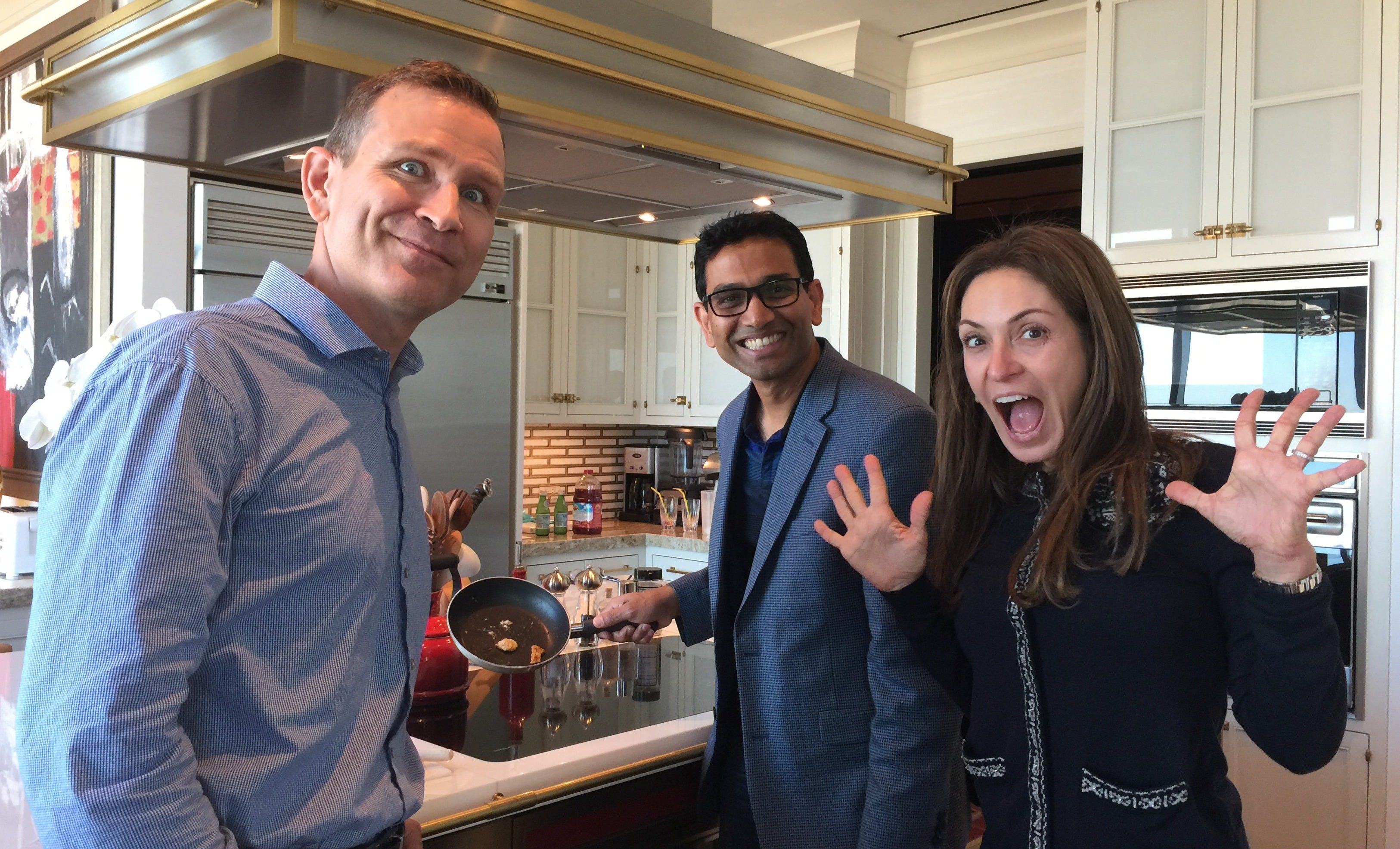
In October 2016, Mayo-trained cardiologist Uma Valeti flew from San Francisco to New York to introduce my good friend Suzy Welch and me to the wonders of real chicken meat, no formerly living chicken required.
Tasting is believing, so Uma brought along some of his company’s chicken—as much as he could afford, since he wanted to make a strong first impression.
Suzy and I each got half a nugget.
We were thrilled.
I’m guessing the meal cost about $15,000.
At that point, very few people had eaten meat grown without an animal: mostly a handful of scientists and the small teams at the few companies that existed, all of which had been launched within the previous year.
Fast forward a bit more than eight years, to March 2025, a back room at Oyamel, José Andrés’s downtown DC restaurant: More than 60 DC politicos sat down to a five-course meal built around cultivated meatballs from Mission Barns and cultivated salmon from Wildtype. Members of Congress from both parties were at the table. Earlier in the day, a Republican from Michigan, a self-proclaimed gourmand, tried Wildtype’s salmon and announced: “My taste buds are dancing!”
These anecdotes illustrate what I’ve come to believe over the past decade, which is this: If cultivated meat does not reach price parity with conventional meat, it will be because we failed at execution and not because the science turned out to be impossible, or even terribly complex, relative to early expectations.
Over the past five years, there have been some very high profile obituaries written about cultivated meat. And then one by one, their assumptions have been proven wrong.
This is common with innovation: The conventional wisdom of human beings generally aligns with the idea that if something has not happened yet, that probably means it’s impossible.
We’ve seen this with everything from airplanes and automobiles to internet commerce and artificial intelligence: The early conventional wisdom was somewhere between dubious and incredulous for each of these technologies and many others that became wildly successful. That’s what I believe can happen with cultivated meat.1
The cultivated meat obituaries do capture something real, though:
A handful of US states have banned the sale of cultivated meat, and the European Union has not yet approved its sale.
Financing for capital expenditures has been incredibly hard to come by.
Regulatory approvals have dragged on for years after reviews were finished.
This confluence of factors has dampened investor enthusiasm. As a result, some companies have failed, while others have had to scale back spending, including on research and development, creating a vicious cycle.
A key point: None of this is an indictment of the science; I have a section in chapter 6 of Meat titled “I got 99 problems but the tech ain’t one.” It walks through some of the struggles of cultivated meat startups, and it lands on a few key points:
Running a company is hard.
Running a company in a brand new sector is even harder. As my good friend Liz Specht from Food System Innovations (FSI) explains: “There are financial management challenges and business strategy disagreements and interpersonal conflicts and all of the other potential pitfalls that arise when humans tackle a complex endeavor where the stakes are high and there is no one right answer.”
There have been other challenges for the cultivated meat sector in recent years, including the aforementioned long waits for regulatory approval and difficulty raising the money necessary for critical infrastructure.
The science of cultivated meat looks more and more promising every year.
The science remains strong.
Look at the price curve: In August 2013, Mark Post, a Ph.D./MD professor of tissue engineering at Maastricht University and former professor at Harvard Medical School, cooked up the world’s first cultivated burger, courtesy of a grant from Sergey Brin.
That burger cost €250,000 for 142 grams of meat. In December, Mosa Meat announced that they’d brought costs down by a factor of 100,000 (or 99.999 percent), which puts them at around €8 a pound by my calculations.
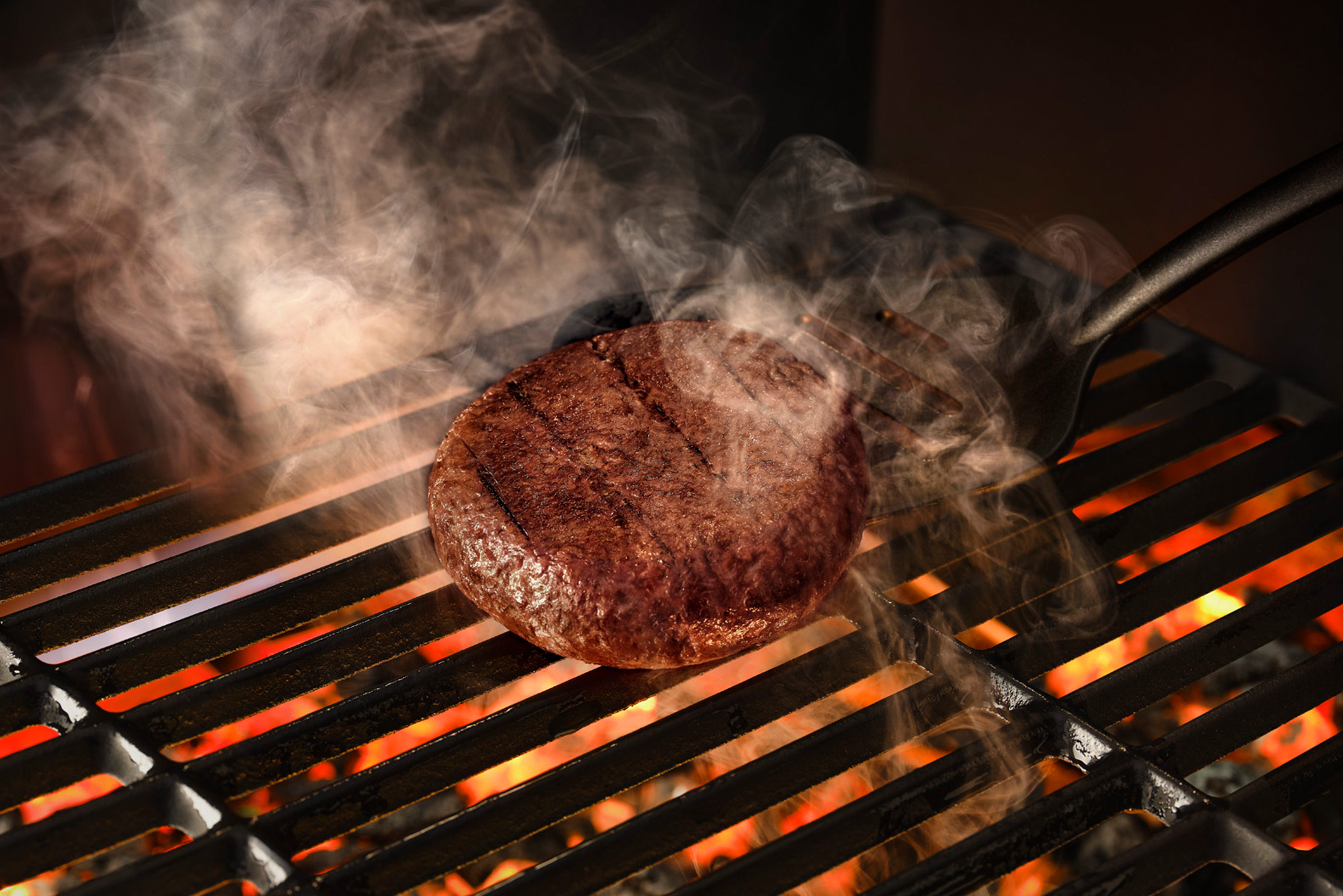
Wildtype’s input costs for salmon are under $10 a pound, and co-founder Justin Kolbeck told me the only thing keeping the finished product expensive is scale: “None of this depends on a technology breakthrough. We already have the science and the recipe. It’s a manufacturing volume problem, and that is solvable with time and capital.”
Uma says Upside has cut its costs by 99.99% in under a decade and that their real challenge now is scaling. The two things that Upside needs for success are a more transparent regulatory environment and capital investments in infrastructure.
Zak Weston from Food System Innovations (FSI) tells me that in his view, “the technological progress over the past few years has been remarkable.” Zak works on market shaping for FSI and has personally reviewed techno-economic analyses from five different cultivated meat companies. He says that those analyses show “that at current cell line and media performance, if produced in commercial-scale facilities, they could reach cost parity or cost advantage compared to their animal meat benchmark.”
Considering how little money these companies have raised (more in a moment), the state of these startups blows my mind. Imagine where they would be if regulatory schemes were more clear and funds were available for scaling.
“At current cell line and media performance, if produced in commercial-scale facilities, [there are five startups that] could reach cost parity or cost advantage compared to their animal meat benchmark.”
—Zak Weston, Food System Innovations
The landscape is even better than private sector progress would indicate.
In October 2015, Mark Post convened the world’s first conference to explore the science of cultivated meat.
Of the 21 science-focused presentations at that conference, 19 of them were delivered by Mark’s colleagues in tissue engineering for human medicine or conventional meat sciences, recruited by Mark to speculate on how their work might apply to cultivated meat production. The only two hard science presenters who were working in cultivated meat were Mark himself and University of Bath tissue engineering professor Marianne Ellis. Notably, both Mark and Marianne continue to devote their careers to the cultivated meat endeavor.
Now, there are hundreds (at least) of university scientists all over the world who are advancing the science of cultivated meat, mostly working via grants from their respective governments. There are also hundreds of private sector scientists, including more than 100 in Mark’s lab alone.
To me, the caliber of scientists dedicating their careers to this space is one of the most encouraging signs of its viability. Many of them are in the upper echelon of the scientific establishment, and they have a broad range of appealing options. They’re choosing cultivated meat because they see the incredible potential for the world, and they see a viable path forward for the technology.
Take David Kaplan, who was serving as Chair of the Department of Biomedical Engineering at Tufts, with more than 1,000 peer-reviewed papers under his belt, when New Harvest fellow Natalie Rubio brought the idea of cultivated meat to him in 2016. Since then, he’s gone all-in, overseeing graduate students, authoring journal articles, and launching the National Institute for Cellular Agriculture, with a $10 million grant from the USDA. Kaplan’s cultivated meat lab has grown to more than 20 full-time researchers in less than five years, bolstered by USDA and Massachusetts state government grants.
At Tufts’ annual conference on cellular agriculture in 2024, I asked David how he was feeling about the field’s trajectory (video here). “In the last three to five years,” he told me, “the progress on cell isolation, cell immortalization, media cost reduction, and many other factors gives me complete confidence that we’re going to get to where we need to go.” I asked the same question in 2025 and again in 2026, and received similar answers; every year, he becomes more optimistic about the science of cultivated meat and more encouraged by the progress the sector is making.
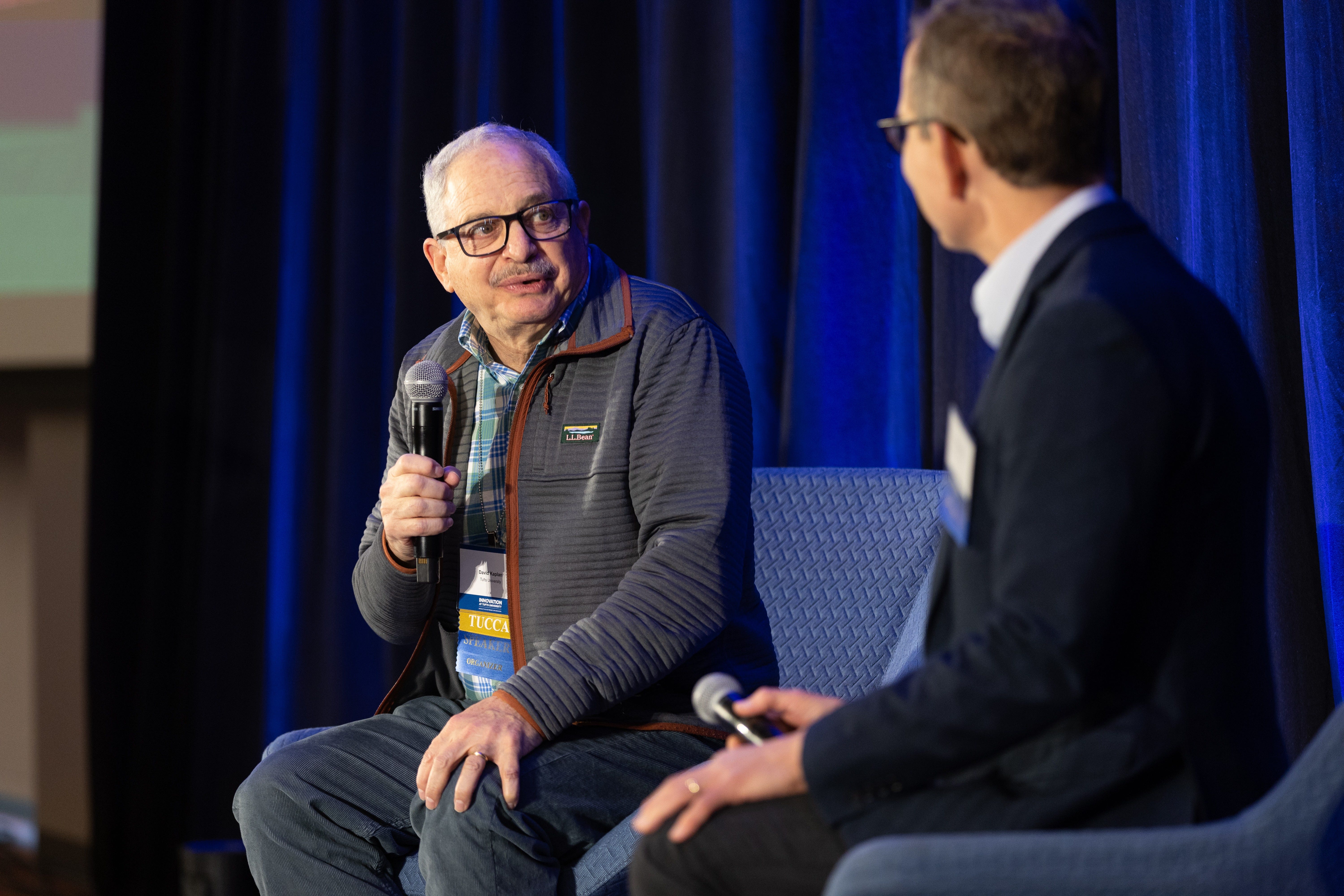
“In the last three to five years,” Professor Kaplan told me, “the progress on cell isolation, cell immortalization, media cost reduction, and many other factors gives me complete confidence that we’re going to get to where we need to go.”
For my book, I surveyed dozens of cultivated meat scientists and interviewed more than a dozen. My survey asked two questions:
Can cultivated meat reach taste and price parity with cheap chicken and fish?
If so, how much government support will be required?
Every single scientist agreed that cultivated meat could almost certainly reach price and taste parity with cheap chicken and fish, assuming sufficient government support. No one argued that the science could not work. Many comments were similar to David Kaplan’s: Progress over the past five years has been far beyond expectation.
Eric Schulze is a molecular biologist and chief technology officer at the cultivated meat company Evergreen. Eric spent six years at the Food and Drug Administration evaluating novel biotechnologies before joining Upside Foods and then Evergreen, which was founded in 2021 by Ali Khademhosseini, a former professor at both MIT and Harvard Medical School, and one of the world’s most renowned tissue engineers.
In response to my survey, Eric replied: “If cultivated meat weren’t feasible, researchers would already know. There’s no evidence we can’t invent new ways to lower costs. If anything, you could almost calibrate a watch to the pace of breakthroughs.”
That confidence is echoed by others. A late-2022 Nature Food study led by Hebrew University professor Koby Nahmias shattered multiple assumptions about cell density, media costs, and production efficiency. Koby was the one person interviewed for my book who said he was convinced that cultivated meat could reach price parity on its current trajectory, regardless of government support, as long as VC support for cultivated meat startups didn’t grind entirely to a halt.
No one is paying more attention to the science and scaling challenges of cultivated meat than GFI lead scientist for cultivated meat Elliot Swartz, who told me in 2025 that the two primary cost drivers for cultivated meat, media costs and bioreactor costs, had been falling much more quickly than anyone expected.
The first principles analysis couldn’t be much better, Elliot pointed out: As media formulations and production become more efficient, cultivated meat’s feed conversion ratio should end up being around one third that of chicken. “If humanity wants cultivated meat to be cheap, we can make it cheap,” Elliot said matter-of-factly.
A scientific ecosystem takes shape
In How Solar Energy Became Cheap, University of Wisconsin professor Gregory Nemet talks about the importance of academic papers and conferences to solar energy’s success. Papers and conferences create the pool of knowledge that allows technical challenges to be surmounted and prices to come down. That machinery is now running for cultivated meat.
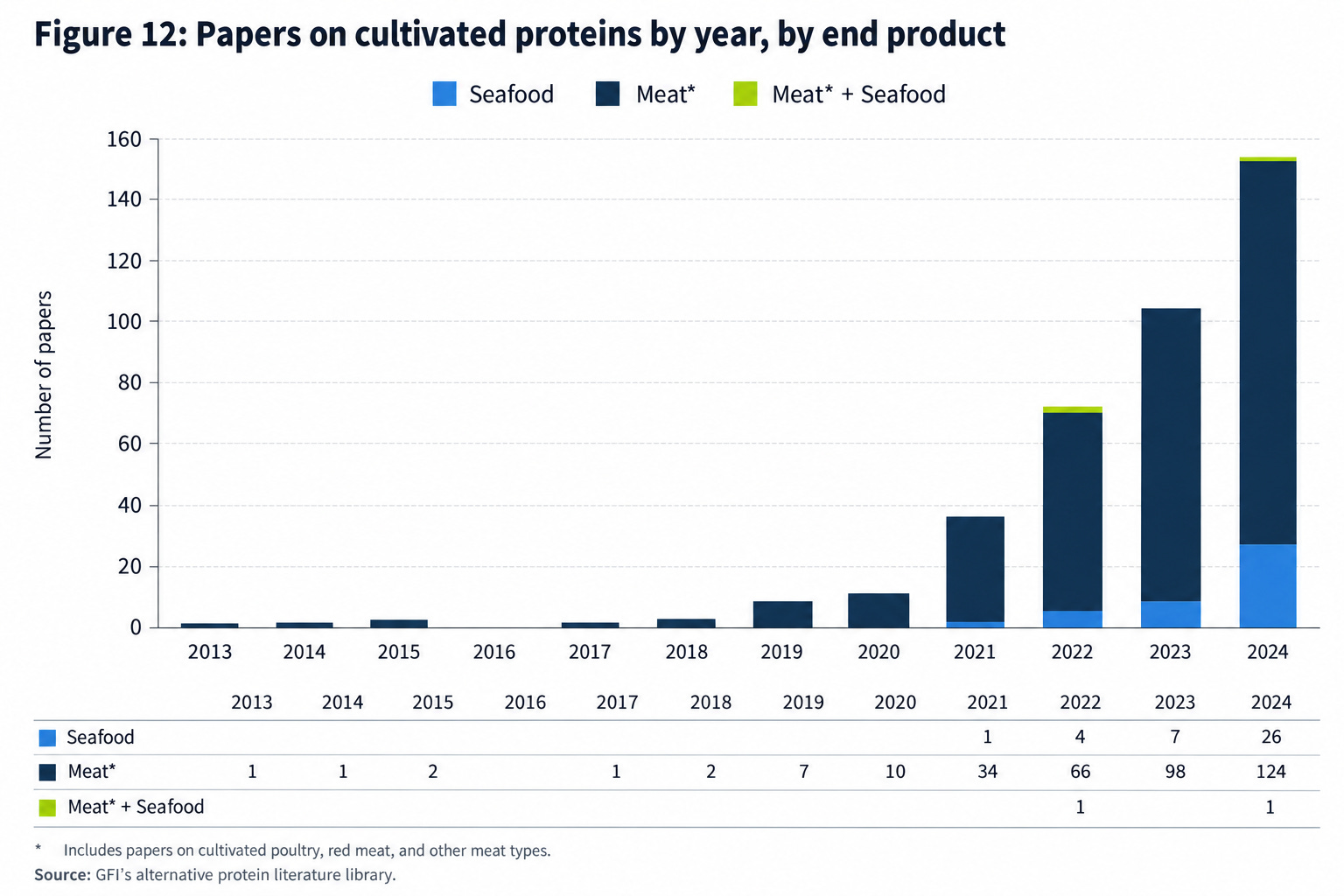
Between 2013 and 2020, a total of 24 peer-reviewed papers focused on the science of cultivated meat were published. As a result of GFI’s competitive grant program and government support for science, we have seen those numbers climb steadily every year since. In 2022, there were more papers published than in all previous years combined. The number continues to climb, reaching 105 in 2023 and 151 in 2024.
In 2024, Nature Biotechnology reached out to discuss an editorial. After researching the technological challenges and public health benefits of cultivated meat, the editors made the case that governments should help to ensure its success, noting that “with better coordination between public and private efforts, cultivated meat will both do well and do good.”
Alongside the funding and the publications has come a nonstop stream of conferences: multiple every year in many developed countries, as well as in Brazil, India, and China.
In 2024, the Bezos Earth Fund (Jeff Bezos’s 10 billion-dollar climate philanthropy) launched three new centers of excellence at top universities selected through a rigorous process in partnership with GFI’s science team. The three winners: Imperial College London, the National University of Singapore, and North Carolina State University. Imperial and NC State now host their own annual conferences, and all three centers are active on the global stage.
Also in 2025, Gordon Research Conferences approved a proposal for a new conference on alternative meats, formally recognizing the field as a frontier area of scientific inquiry and bringing it into their prestigious series of research-focused meetings. In January 2026, the first conference assembled hundreds of brilliant minds across the global research community to share information and advance the science of plant-based and cultivated meat. Going forward, these events will happen every two years.
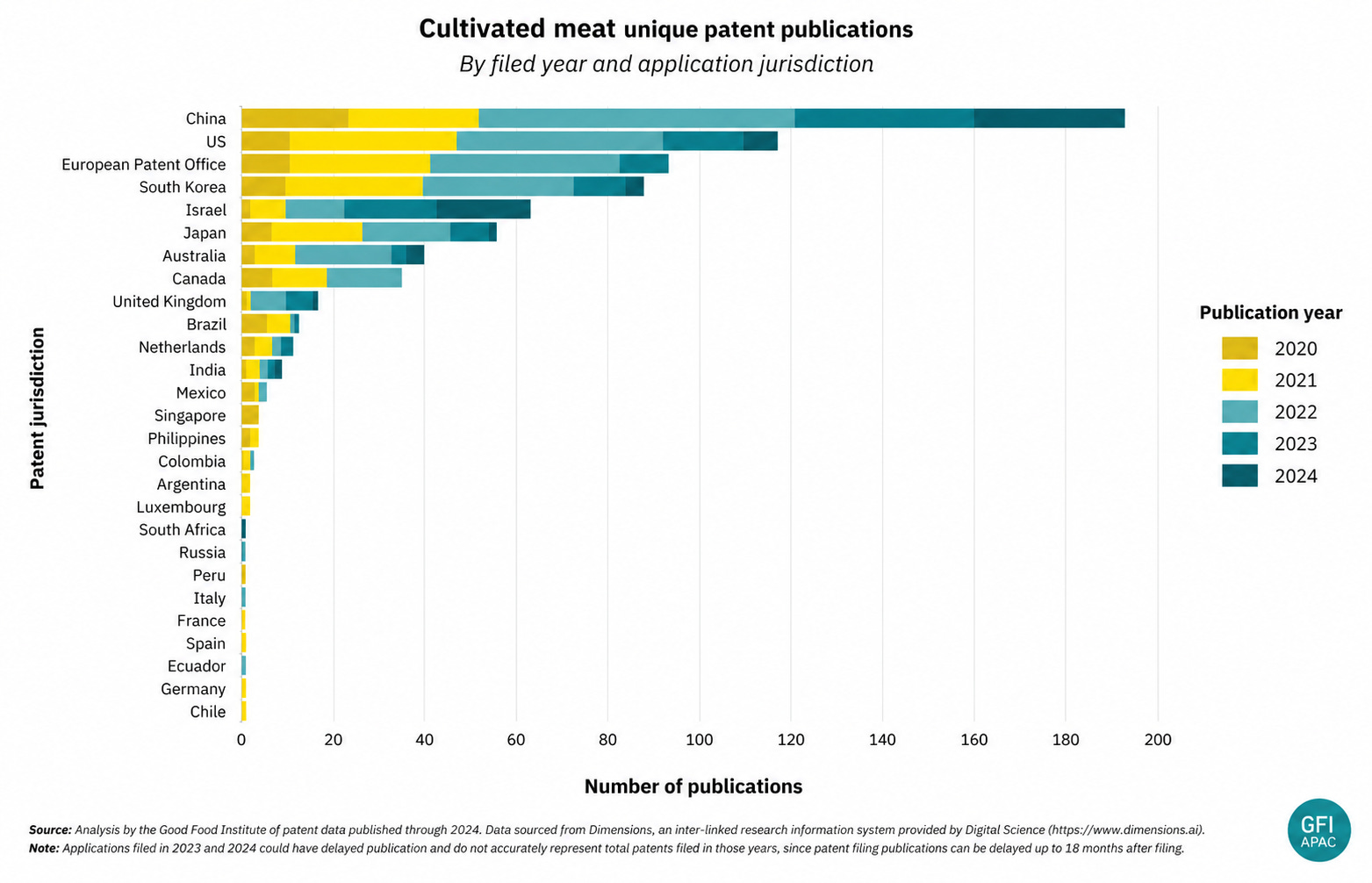
Patents tell a similar story. Between Mark Post’s public launch of the first cultivated burger in 2013 and the founding of the first eight companies in 2016, the entire field saw just 10 patents published. Between 2017 and 2026, that number exploded to more than 1,600.
This includes work from foundational companies like Upside Foods, Mosa Meat, Aleph Farms, and Believer Meats—each one founded by medical doctors or PhDs in bioengineering (or both). Interestingly, China is home to eight of the twenty most active patent holders. Patent activity captures just a sliver of private sector scientific progress, since many scientific and technical advancements are protected not as patents but as trade secrets.
The private sector is doing a lot with a little.
The private sector has taken a beating, for the reasons I laid out at the top. That said, it’s my strong impression that the still-standing cultivated meat companies are scrappy, impressive, and significantly undervalued. They definitely continue to make real progress.
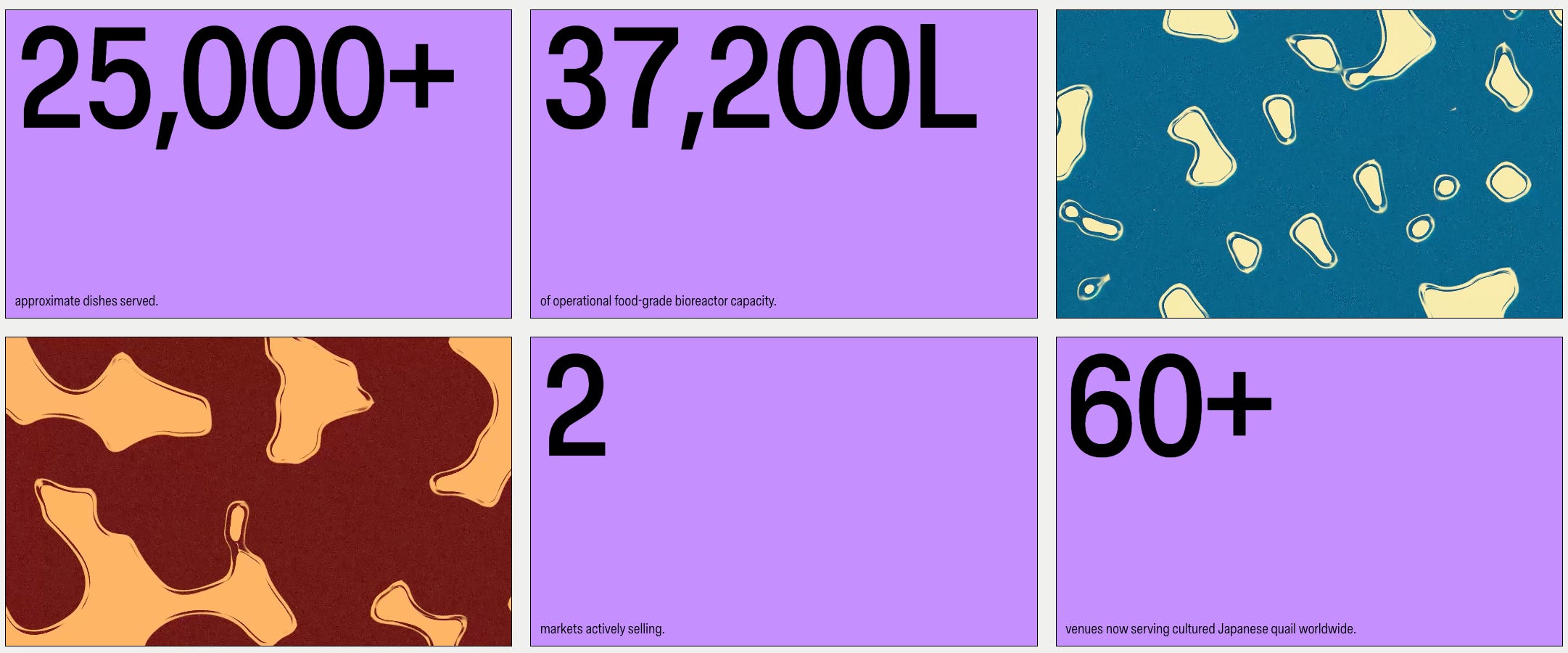
For example, Australia-based Vow was founded in 2019 by biochemist and chef George Peppou, and it took its quail from idea to commercialization in just five years—on an annual budget of less than $10 million. That includes everything: not just R&D, but also operations, staffing, and infrastructure.
On top of that, they navigated Singapore’s regulatory process and became the first cultivated meat company approved to sell its product in Australia and New Zealand. That timeframe and budget are extraordinary for a product that wasn’t for sale anywhere on the planet until December 2020 and that still has no production infrastructure to build on.
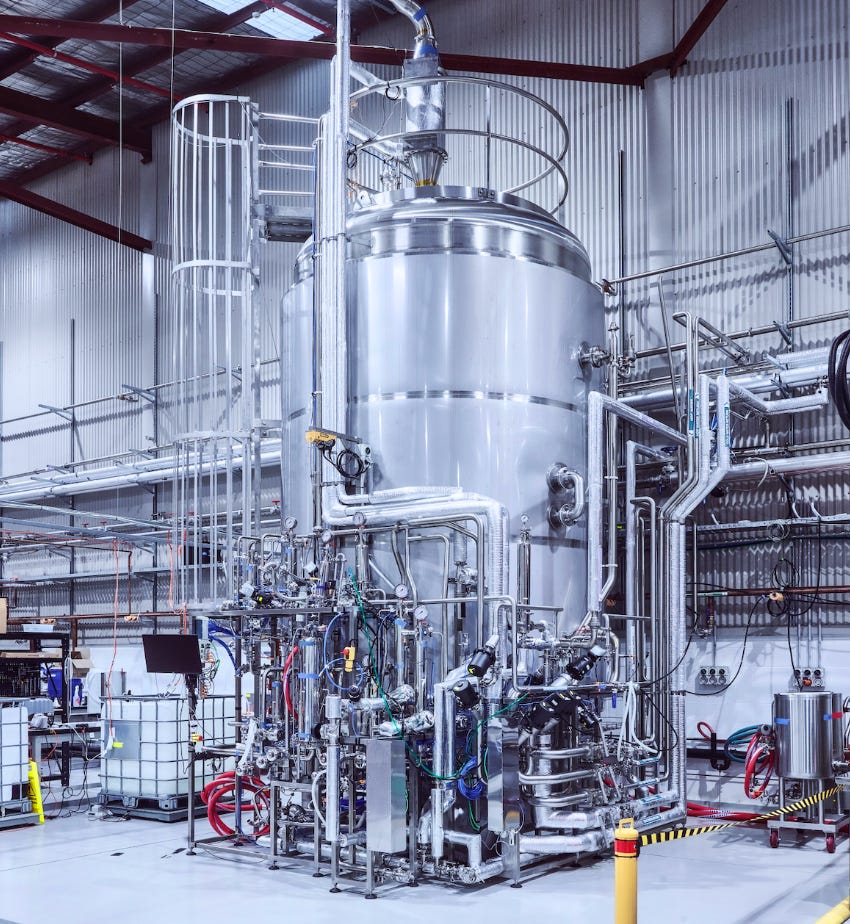
Vow is now producing meat in a 22,000 liter cultivator. Founder and CEO George Peppou told me that this one bioreactor can produce 5,000 kilograms of meat per week. Right now, that meat is available for purchase at more than 60 restaurants in Australia and Singapore.
Upside Foods was founded by Mayo-trained cardiologist Uma Valeti. Upside was the first cultivated meat company to raise a seed round, the first to raise a series A, and the first to land investments from the big meat companies (Tyson and Cargill are both investors). Upside’s 99.99 percent cost reduction has come from slashing media costs and scaling production 10,000-fold since 2020, Uma told me.
In 2023, Wildtype finished construction on their second cultivated salmon pilot plant by upgrading a former brewery, and they have been producing salmon there ever since. I’ve been there repeatedly in my capacity as a founding board member of Food Solutions Action, as we have introduced both Senators and House members, Republicans and Democrats, to the wonders of mercury-free and microplastics-free salmon. Enthusiasm is universal and bipartisan.
Co-founders Justin Kolbeck and Aryé Elfenbein are great ambassadors for the alt meats endeavor. Justin has an MBA from Yale and served for six years as a foreign service officer in Australia, Pakistan, and Afghanistan. Aryé has a Ph.D. in vascular biology and an M.D., both from Dartmouth, and trained in cardiology at Yale’s medical school and the Gladstone Institutes. They constructed their current plant for just $15 million and are committed to what Justin calls the “scrappy, modular approach” to increasing capacity, about 250 tons at a time.

Meanwhile, the supporting infrastructure is arriving. There are contract manufacturers like the Cultured Hub in Switzerland, which opened in 2024. Massachusetts granted $2.1 million to Tufts to establish a pilot cultivated meat facility on campus, which just opened for business and includes a cell bank and lab space.
Another exciting development: the rise of companies focused on single parts of the supply chain. Today there are cultivated meat startups specializing in media formulations, cell line development, and cultivator design. These companies exist to license their innovations broadly, meaning their breakthroughs have sector-wide benefits similar to open-access research.
As one example among many: Tim Olsen earned a bachelor’s, master’s, and Ph.D. in bioengineering and then worked for years as a biomedical engineer. From 2020 through 2024, he oversaw the cultivated meat work for the German pharma company Merck KGaA, managing a global team of more than 20 Merck scientists. In 2025, he left to start EdiMembre, a company that supplies bioreactors to the rest of the industry, with a focus on structured meat products.
All that said, the linchpin of success will be government support; fortunately, that’s also on a positive trajectory.
Government support for cultivated meat science: from zero to hundreds of millions in under six years
Until the fall of 2020, there had been just three government grants for cultivated meat research: two very small NASA grants in 1995 and 1998, and then one significant Dutch grant spanning 2005-2009, to Dutch researcher Mark Post. From 2010 until late 2020, there was nothing.
In the six years since, there have been hundreds of millions of dollars in government grants for cultivated meat research, from all of the governments that invest the most in biotechnology or agriculture.
In chapters 9 and 10 of Meat, I walk through the two principal reasons that governments are funding cultivated meat research:
the economic opportunity: The meat and seafood industries generate $2 trillion in sales per year, and that’s growing; and
food security: Cultivated meat requires a fraction of the land and inputs, relative to conventional meat, and its supply chains are far less fragile. The land and resource benefits of cultivated meat are appealing for countries that are currently significant food importers. The far less fragile supply chain is appealing to all countries, and also to major food and meat companies.
The governments most supportive of cultivated meat generally are Israel, Singapore, and China—Israel and Singapore because they import almost all of their food and would like to import less, and China because its food self-sufficiency metrics have been going in the wrong direction since it joined the WTO more than 20 years ago.
Honorable mentions go to the UK, the Netherlands, Germany, South Korea, Canada, the US, Brazil, and India—for reasons I dive into in the book, alongside examples of these countries’ support for the technology.
That government money matters. Company-funded science is aimed at competitive advantage. It might solve a key challenge for that company, and when companies announce breakthroughs, that also serves as a signal of what’s possible. But public sector science, especially when open access, solves scientific challenges for everyone.
As I detail in chapter 9, industrial policy is how developed economies got that way, and it has been essential to most major innovations of the past 100 years. We need those policies for plant-based and cultivated meat, too.
This is the work I spend my days on. GFI’s top goal is to build a scientific ecosystem focused on solving the challenges of price and taste competitive plant-based and cultivated meat, and the way we do that is by convincing governments to fund the most important science.
Our scientists work with government scientists in every country where we operate, helping them understand both the value of this research to critical government goals and which research matters most. The aim is to turn our $35 million/year budget into billions of dollars of high-impact government science funding.
What a difference a decade makes.
A few months before that dinner at Oyamel, Uma gave a talk at TED Countdown, TED’s climate conference, and all 200 attendees were served Upside chicken as part of the day’s lunch. It was the largest cultivated meat meal ever served. More remarkable: when the caterer ran out of mushrooms for the appetizer, they replaced the mushrooms with cultivated meat. My mind was blown.
Upside has kept it up. In early 2026, they threw a book party for me at their HQ, with unlimited cultivated meat for all. They did it again at the Commonwealth Club World Affairs in August, for a crowd of 135 people. That crowd was also treated to cultivated salmon courtesy of Wildtype and Impossible Foods meatballs.
Now think about what all of that cost. Total investment has reached about $3.4 billion, which has funded more than 150 companies worldwide, covering not just R&D but equipment, rent, production tests, salaries, and everything else. Again: That’s an all-time total, from the first pre-seed investment in October 2015 through today.
That’s less than the cost of a single EV battery factory. It’s less than it would cost a massive pharma company to bring three new drugs to market, at an average of $1.3 billion per drug (and that’s for a company that already has all the necessary equipment and infrastructure and regulatory systems in place).
In fact, the cost of bringing one drug to market is more than twice the amount raised by the best-funded cultivated meat company, Upside Foods, for all its operations going back to 2015.
Here’s the ledger:
Cultivated meat went from something a startup could only afford to serve to their most important potential investors (and those investors were lucky to get half a nugget) to serving 200 people at TED Countdown, 60 at a bipartisan dinner in Washington, and hundreds at multiple Bay Area book parties.
Prices fell by 99.999% at Mosa Meat, and to a comparable level at Wildtype, Upside Foods, Vow, and other companies.
Government funding went from two governments ever to dozens of governments and hundreds of millions of dollars.
Peer-reviewed journal articles went from a trickle to 160 a year and growing.
Patents went from 10 to more than 1,600.
The entire endeavor could still fail (or be delayed a decade or more).
None of that is to say success is guaranteed. The startup ecosystem remains small, and running a business is hard. Besides, no technology goes from concept to popular product quickly, FSI’s Liz Specht tells me. Declaring a scientific endeavor dead based on early struggles in the private sector “would have declared virtually every facet of our modern life dead on arrival.”
Speaking with Liz, I thought about the fact that the two major media outlets that declared cultivated meat dead both did so with no meaningful discussion of the science, no discussion of innovation ecosystems, and no engagement with the obvious answers to their 85 percent strawmen analyses. Both stories could be summed up: This has not worked yet; ergo it’s failed. Past tense. Over.
I think a lot about the fact that in the early days of the automobile, the early entrepreneurs were mocked: The cars were hard to start, they were expensive, and they kept breaking down. More than 500 car companies went out of business. Very few survived. But those few created the largest industry in America over the course of just a few decades.
Fast forward ~100 years to the dot-com bubble. The NASDAQ lost almost 80 percent of its value, as $5 trillion dollars went up in smoke. Way more than 500 internet commerce companies failed. Amazon fell by 97 percent. The obituaries were swift and merciless: Who would buy pet supplies online? Who wants this? What is Jeff Bezos thinking? Brick-and-mortar stores are irreplaceable. Ordering online is excruciating—and people steal your packages!
Of course the bubble popped.
Nope. Within a decade, the conventional wisdom had all been proven wrong. Consumers got broadband, the infrastructure scaled, companies got better (and better and better and better) at meeting consumer needs, and the original vision proved not just possible but transformative. Chewy is now worth close to $10 billion (~25x as much as pets.com at its height). Amazon turned a modest profit in 2001 and then rocketed to $1 trillion in market value by 2018 and $2 trillion in 2024.
The evidence shows, I believe, that we can do the same kind of thing with cultivated meat, and that’s a big part of why I wrote Meat, which lays out my case over 11 chapters and then offers some suggestions for how readers can help meat alt meats a reality at scale.
I believe that our most likely path to success is a maximally robust open access scientific ecosystem, funded by governments; that’s how we make cultivated meat a commodity product.
That’s also what’s happened with renewable energy, electric vehicles, and many other innovations (e.g., both of the major advances in EV batteries came out of the US Department of Energy). We’re on the right trajectory, but we need to sustain it, and we need the funding and ecosystem of scientists and engineers to grow. That’s how we lift the entire global cultivated meat project.
Success will also require long-term, low interest loans for infrastructure—that’s precisely what governments have offered to other nascent industries (including renewables and EVs); we’re going to need it here, too.
Finally, the rest of the world should follow the regulatory lead of Singapore, the US, Israel, and Australia/New Zealand. Most urgently, the Europeans need to move more quickly and transparently on food safety review. The United States has been a leader, but as I write this, there appears to be a regulatory bottleneck; that needs to change.
The playbook is clear. But that doesn't make it easy. It will require time and money and a lot of very smart and driven people pushing to make it happen.
As Elliot told me when I interviewed him for the book, “If humanity wants cultivated meat to be cheap, we can make it cheap.”
Cultivated meat can be the future—if we choose to build it.
This essay was adapted from chapters 6 and 11 of my recently published book Meat. Publishers Weekly named Meat a top 10 new release in science, and Nature named it a top 5 science pick. Meat has also received positive coverage from the Guardian, Atlantic, and Financial Times, as well as accolades from Jane Goodall, Peter Singer, Christiana Figueres, Steve Jurvetson, Kim Stanley Robinson, and more.
It's great to see you Substacking Bruce -- particularly about what I think might be the most important issue on the planet. Though human cruelty to other humans is frequently shocking, it pales in comparison with what we do to the other sentient species. After over 25 years in the animal rights movement, I have come to believe that cultivated meat may be our only way to curb those horrors. Whatever other advantages cell-cultivated meat may have, I thank you, wholeheartedly, on behalf of animals, for what your work in this field will do for them.
Heading into the work-weekend feeling so motivated upon reading this!! These optimism boosts are pure fuel.